Sunday, February 9, 2014

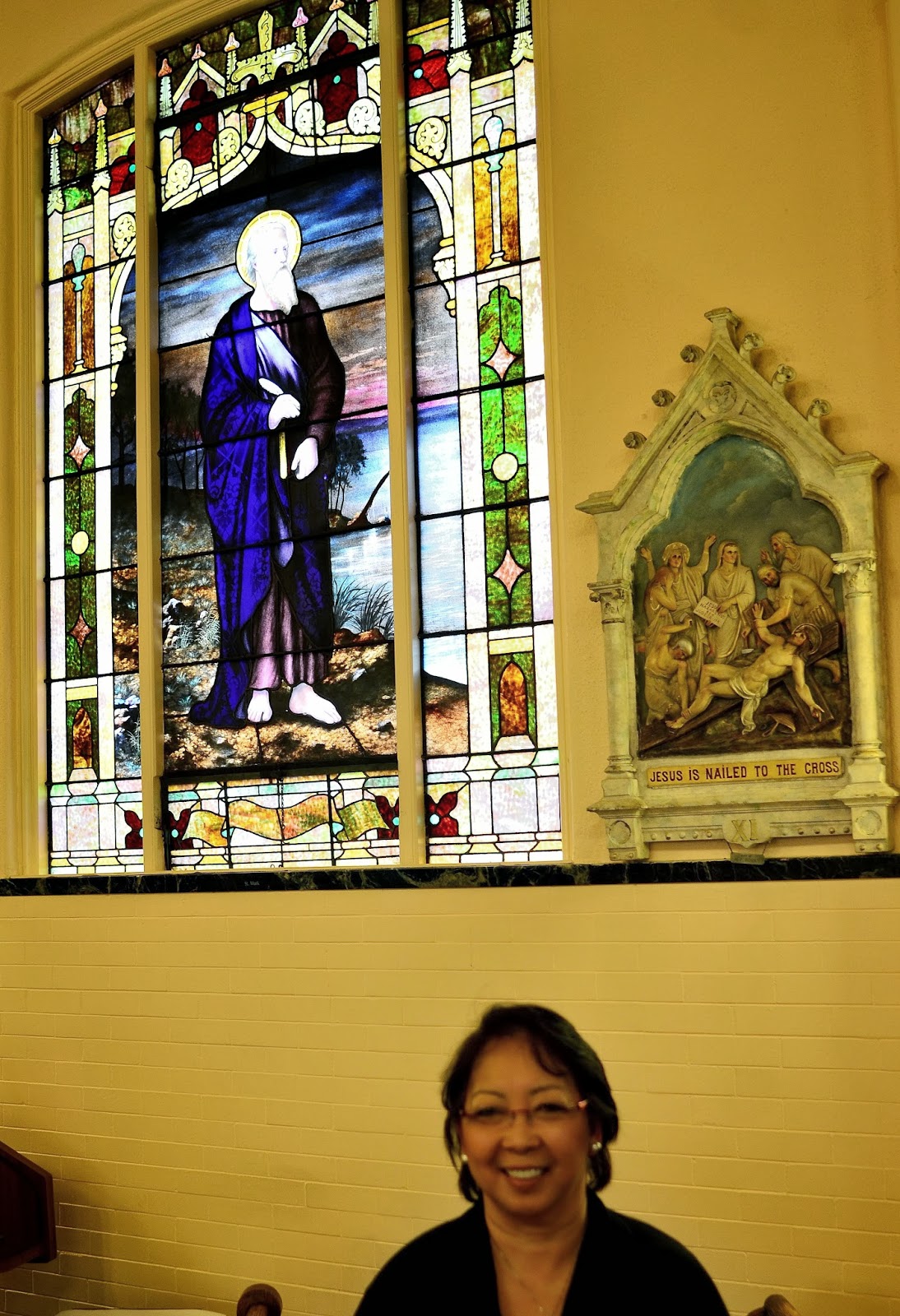
Church #8 - St Joseph Catholic Church, 969 Ulysses Street    Golden, Colorado 80401 

February 09, 2014
11:00AM Sunday Mass

Sunday Mass was presided over by a very old Jesuit, although St Joseph's isn't a Jesuit Parish.   We got there in time for the short but meaningful Homily on the "salt of the earth" theme.   In typical Jesuit fashion, the Homily was short, to the point, and punctuated with humor.   At the end of the Eucharist, the choir sang Happy Birthday to the old Padre and the congregation gave him a standing ovation.

We both figured that St Joseph takes the #3 rank in our favorite churches to date.   #1 remains Week 7's St Elizabeth of Hungary followed by Week 3's St Ignatius Parish.   Jesuit bias?  Perhaps!


From St Joseph's website (http://www.stjoegold.org/history.html): St. Joseph Catholic Parish was founded in 1859 by Father Joseph Machebeuf. The first white-frame church structure was finished in 1867 on a site on the north side of 14th Avenue near Ford Street. Judge Jonas Johnson donated that site and in 1874 he donated another twenty acres (where the present church complex is located) as a cemetery and possible church site.

This tiny church was the second church built in Golden. The Baptist (1866), Calvary Espiscopal (1869), Swedish Lutheran (1870), and First Presbyterian (1870, now the Foothills Art Center) churches also served pioneer Golden, a one-time territorial capital and urban rival of Denver. Golden population peaked at 2,730 in 1880 and then its population declined when it lost the territorial capital to Denver as well as its hopes of becoming the Colorado railroad hub. Despite the dwindling population, St. Joseph's struggled to stay open. Thomas McGrath became the first resident pastor in 1871, followed by Fathers L. B. Lebouc (1872-1873), S. Duroc (1873-1881), Anthony J. Abel (1881-1886), Martin P. O'Driscoll (1886-1888), George J. Morton (1888-1890), and Daniel Lyons (1891). In 1891, Bishop Matz, with some relief, turned over the poor, struggling parish to the Franciscans in Denver.

Bernard Spiegelberg, O.F.M., began an ambitious pastorate in 1891 and in 1899 built a new $8,000 brick church on the east side of the original frame structure. The Franciscans worked to pay off the parish debt and returned a debt-free parish to the Denver diocese in 1913.

Father Robert Servant was appointed to St. Joseph Parish by Bishop Matz in 1913 and he served until his death in 1924. He was followed by Father John P. Moran (1924-1940) who built the mission of Christ the King (1936) in Evergreen. Father Barry Wogan guided St. Joseph's until 1949, adding a $19,959 hall north of the church on East Street. This hall served Catholics and non-Catholics alike.

After World War II, Golden's growth finally began to match the golden hopes of its town founders. The town grew from 3,175 in 1940 to 7,118 in 1960, and to 12,237 in 1980. St. Joseph's parishioners were overflowing the old 1899 red brick church by October 3, 1958, when Archbishop Vehr dedicated a new $135,000, 450-seat church. Located across East Street from the old church, it was designed by architect John K. Monroe as a basement church able to sustain a traditional ecclesiastical superstructure if future growth required it.

The old church, rectory, hall, and grounds were sold in 1965 for $130,749 to the Adolph Coors Company, which demolished the structures to expand its parking lot for tourists, who came in ever-increasing numbers to inspect the huge brewery and sample its products. Proceeds were used to begin construction of a $227,870 eight-classroom school on the 10th Avenue and Ulysses Street site.
Richard Mershon (1964-1970), Monsignor Thomas P. Barry (1970-1976), Monsignor Edward A. Leyden (1976-1977), Father George V. Fagan (1977-1982), and several interim pastors guided St. Joseph Parish through years of rapid growth in Jefferson County, where it had once been the only parish. St. Joan of Arc Parish (1967) in Arvada, and Our Lady of Fatima (1958), and Christ on the Mountain (1975) parishes in Lakewood were established to care for newly-suburbanized areas once within the boundaries of St. Joseph.

Even with these new parishes, St. Joseph's continued to grow. Angelo Ossino, who became pastor on July 1, 1982, began working with the Council on plans for a new parish plant on the twenty-acre expansion site on the north side of the Golden Cemetery, which Judge Johnson had donated in 1874. The result is a $1.6 million church and rectory. For the October 19, 1986 dedication, a procession of parishioners carried the crucifix from the old church to the new. The old cornerstone and church bell of the 1867 church were also brought to the new site and placed at the outside entrance.
The church is pinned to a hillside by more than 150 caissons and designed to be warm and welcoming, to have the earthy feeling of the nearby foothills. The pie-shaped structure seats over 500 with no one more than nine pews from the altar. Designed by architects Keith Ames and Associates of Longmont, the dramatic exterior of brick and raw wood rises to a central cone over the altar. The exterior features a solar wall and garden, with a baptismal font just inside the main entrance. Custom handcrafted furnishings adorn the interior, including a suspended sculptural ceiling in the Eucharistic chapel and Stations of the Cross carved in glass. Under its huge conical roof, the complex contains a record vault, a reconciliation room, a chapel, offices, a gift shop, and a kitchen.

Archbishop J. Francis Stafford anointed the altar with holy oil, sprinkled parishioners with holy water, and set off the smoke detectors with clouds of incense. Parishioners thanked the archbishop with a traditional western "Howdy!" by presenting him with a Stetson hat. Thus, St. Joseph, the second church to be built outside Denver by Bishop Machebeuf, became the first new Colorado church to be dedicated by Archbishop Stafford. Excerpted from Colorado Catholicism by Tom Noel, Copyright 1989 Archdiocese of Denver

For more, please visit their website.

Sunday, February 2, 2014

Church #7 - St Elizabeth of Hungary Church, 1060 St Francis Way, Denver, CO 80204

February 2, 2014
9:00AM Sunday Mass

From the moment we stepped into the little church, we felt very good vibes from the place.   Hard to describe the feeling other than "good vibes".   As we stepped into the church, we were handed little tapers - as were all congregants.   Before the Mass started we were asked to gather around the doors area and turn around to face up to the balcony area where the co-celebrants sprinkled the congregants with water from a whisk broom.   Then we were told to light the tapers and head back to our pews.

This taper ceremony, apparently is a Parish annual tradition ... I can't remember what its significance was, unfortunately.   The Homily was somewhat interesting - especially since it didn't involve any "circular logic".

After Mass we jointly decided that St Elizabeth of Hungary was now our #1 ranked church, dislodging Week 3's St Ignatius.


From St Elizabeth of Hungary's website (http://stelizabethdenver.org/):   In 1870, Denver’s large population of German immigrants petitioned Bishop Machebeuf for their own priest. In 1878, the bishop established Denver’s second Catholic parish, St. Elizabeth of Hungary.  This new parish served the neighborhoods of Auraria and Southwest Denver.  In 1887, two Franciscans, Francis Koch, O.F.M. (Order of Friars Minor), and Venatius Eder, O.F.M., responded to Bishop Machebeuf ’s request and came to Denver from Patterson, New Jersey, to found a Franciscan House at St. Elizabeth’s.  In 1890, Fr. Koch built a $20,000, two-story brick school and in 1891, he built an $18,000 rectory.

As the German national church for the entire city, St. Elizabeth’s became so overcrowded that the old building was torn down to construct a new one in 1898. This $69,000 Romanesque church, designed by Father Adrian, OSF, was built of rusticated rhyolite (lava stone) from Castle Rock, CO, quarries. St. Elizabeth’s long tradition of caring for the poor and hungry began early with Fr. Koch and the Franciscan sisters at St. Elizabeth’s. The Franciscan sisters who opened St. Elizabeth Grade School in September 1890, regularly collected money and food for themselves and the poor.  When Fr. Leo Heinrichs, O.F.M., became pastor of St. Elizabeth’s on September 23rd, 1907, Denver’s poor learned they had a friend in the pastor of St. Elizabeth’s, and every morning a line formed at the friary gate. Fr. Madden, the pastor at St. Elizabeth’s in the late 1970s, carried on the tradition of feeding the hungry by organizing a bologna sandwich breadline behind the church.

Thanks to the fundraising efforts of the Franciscans and the generosity of Colorado’s German Catholics, St. Elizabeth’s became the first church in the diocese to retire its debt. This allowed the church to be consecrated on June 8, 1902, by Bishop Matz. The candle holders on the interior sides of the church commemorate this feat.  Next to the church is the friary, built in 1936 by the May Bonfils Trust. Designed by Jacques Benedict, the friary is decorated by a colonnade, Stations of the Cross, and a shrine to St. Francis.

In the 1960’s, after the Second Vatican Council introduced sweeping changes in catholic liturgy, the church interior was completely renovated to its present form in 1968. The beautiful stained glass windows were installed at that time.

For more, please visit their website.

Sunday, January 26, 2014

Church #6 - St Patrick Oratory, 3325 Pecos St, Denver, CO 80211

January 26, 2014
11:00AM Sunday Mass

We ended up at St Patrick Oratory unintentionally as we'd originally set off to go to Our Lady of Guadalupe (which is one of three Catholic Churches in the immediate area).   We drove by Our Lady of Carmel which I assumed was Guadalupe, turned Google Maps off, got down and headed towards the church only to have the congregation spill out its doors - its Mass just ended.   Only then did we realize we weren't at Guadalupe so we assumed that the church near Root Down (a popular restaurant in the area) was Guadalupe.

We got there and was somewhat perplexed by the sign - St Patrick Oratory - and decided that since we were already here, why not attend Mass.   The church itself is pretty small and had that welcoming feeling.   The Mass itself wasn't bad (any homily that doesn't grate my sensibilities gets at least a "passing grade".)

We actually felt St Patrick was our second favorite ... after 6 weeks, second only to Week 3's St Ignatius (the only Jesuit Parish in Colorado.)


From the Capuchin Poor Clare's website (http://www.capuchinpoorclares.org/page109.html) - which unfortunately doesn't give much information ... and their links don't really work:

welcome to the webpage of the Capuchin Poor Clare sisters at Our Lady of Light Monastery.To know more about the history of Our Monastery, our Clarisas Cookies, or our blog please see the links in the top of this page.

Please join us in prayer at Saint Patrick’s Oratory, to see our schedule of Masses and adoration of the Blessed Sacrament as well as the special events in our Oratory please visit the prayer link in the top of the page.

Sunday, January 19, 2014

Church #5 - Queen of Peace Catholic Church, 2295 S Chambers Rd, Ste M, Aurora, CO 80014

January 19, 2014
9:30AM Sunday Mass

The Church was one of the bigger ones we've visited to date ... architected in the "suburban" style of the St Mary's (Prince St, Littleton) and St Thomas More (Centennial) ilk.

The parish priest gave a very vigorous and long accented homily which didn't cause me to figdet or bite my tongue ... so it couldn't have been too bad.

The statue of Mary had a label that read "Our Lady of Antipolo" and was unusual in that Mary was black skinned.


For more information, visit the Queen of Peace Catholic Church website (http://www.queenofpeace.net/) - lots of good information for the congregation and parish but I couldn't find any page that gave a history of the church.

Sunday, January 12, 2014

Church #4 - Cathedral Basilica of the Immaculate Conception (Denver Cathedral), 1530 Logan St, Denver, CO 80203 

January 12, 2014
10:30AM Sunday Mass

It only took us 15 years in Colorado to finally make it to the Denver Cathedral and a few additional weeks before we actually attended Sunday Mass at the Cathedral.   Although smallish by Cathedral size standards, the place was bigger than the suburban churches that had been my semi-lapsed Catholic staples.

Although we got there early-ish, I felt a distinct unwelcoming vibe ... as if the Archbishop of Denver knew what I thought about his politics!   The Mass itself was quite difficult to sit through and the Homily was of the "this is blue because this is blue" circular logic type.   Were this the Gong Show, I'd have gong'd the young priest out of the lectern!    The good thing about our Colorado Church tour is that next week it'll be another church


From the Denver Cathedral website (http://www.denvercathedral.org/) - The Cathedral Basilica of the Immaculate Conception serves as the mother church for the growing faith community of almost 500,000 Catholics, in 144 parishes and missions spread throughout northern Colorado.

The Cathedral houses the kathedra, or chair, from where the Archbishop carries out his service to the Church of Denver as Teacher and Shepherd. Locally, the Cathedral Parish is a spiritual haven for over 700 households.


History of the Cathedral

St. Mary's Parish Church located at what is now the corner of 15th and Stout streets was the first Catholic Church in Denver. Father Joseph P. Machebeuf celebrated the first Mass on Christmas eve of 1860. In 1868, Father Machebeuf was appointed as bishop of Colorado and St. Mary's became the Cathedral.

In 1890, Bishop Nicholas C. Matz built a brick and sandstone building at 1842 Logan Street. Its four floors were used as the Cathedral school and the basement was the pro-Cathedral or temporary Cathedral. John K. Mullen, John F. Campion, J.J. Brown and Dennis Sheedy paid for eight lots for the permanent Cathedral. In 1902, ground was broken for the new Cathedral. Work came to a halt due to a lack of funds caused by questionable investments made by the procathedral rector, Fr. Michael Callahan. In 1905, an energetic assistant, Hugh L. McMenamin or Father Mac, came to the Cathedral and organized fund raising efforts for the work to continue. The cornerstone was laid in 1906 and Father Mac was appointed rector of the Cathedral on July 26, 1908.


The twin 210 foot spires were capped in 1911. The exterior of the structure is made up of limestone from Indiana and granite from Gunnison, Colorado. The altar, statuary, and bishop's chair are all made of marble imported from Carrara, Italy.The seventy-five stained glass windows came from the F.X. Zetter's Royal Bavarian Institute of Munich. With the structure virtually complete, a bolt of lightning struck the west tower on August 7, 1912 and knocked off the top twenty five feet. The spire was repaired before the dedication. The total cost to build the Cathedral was approximately $500,000.


The Cathedral was consecrated in 1921 and elevated to a minor basilica on December 25, 1979. On August 13 and 14, 1993, His Holiness John Paul II celebrated Mass at the Cathedral as part of the World Youth Day celebration held in Denver that year. On June 23, 1997, the east spire of the Cathedral was struck by lightning. Repairs took nine months to complete. The east tower and spire were rededicated on June 23, 1998. On October 27, 1912, the Cathedral of the Immaculate Conception was dedicated. Fifteen bishops and a cardinal, along with local dignitaries, attended the Mass. The following day, the Rocky Mountain News reported, "May the Cathedral of the Immaculate Conception long stand, its spires an expression of the questing, upturned face of humanity, its chimes an eternal call to the spirituality that stirs within us, and its doors a haven to the weary-hearted in search of hope and rest!"


In the years that have followed, the Cathedral has remained a haven to Catholics and non-catholics. Each week the Cathedral provides three daily Masses and six Sunday Masses to the faithful. Over half of those attending are visitors from other parishes and other cities. Each year the Cathedral provides 50,000 to 60,000 lunches to the poor and homeless. While the Cathedral is now an inner-city parish, its contributions to the community continue; and its financial needs are great.


For more information, please visit the Denver Cathedral's website.

Sunday, January 5, 2014

Church #3 - St Ignatius Loyola, 2301 York St, Denver, CO 80205

January 5, 2014
10:30AM Sunday Mass

It was a snowy ride from the southern suburbs to St Ignatius in Denver, Church #3 on our tour of Colorado Churches.   The main attraction (for me) of the place was the fact that it was the only Jesuit Parish in all of Colorado.

Almost as soon as we stepped into the cavernous church, we could feel the welcoming embrace of the congregation, the most diverse one we've seen in our 15 years in Colorado.  In typical Jesuit fashion, the homily was short (I must admit, I was too distracted to catch anything the Padre said).

After Mass, a number of congregants approached and engaged us in conversation.  The feeling of an embracing community definitely emanated from those in the Church.   


From the St Ignatius Loyola website (http://loyoladenver.org/) - The story of St. Ignatius Loyola Parish begins with Sacred Heart Parish, the first Jesuit parish in Denver. Sacred Heart was founded by Rev. John Baptiste Guida, S.J. in 1879. The present church was completed and dedicated on April 25, 1880. Sacred Heart grew so rapidly that in ten years the church was too small for the congregation. In 1890, lots were purchased at East 26th Avenue and Ogden, and Loyola Chapel was built there in 1909.

Almost from the beginning, Loyola Chapel was unable to handle the overflow crowds from Sacred Heart, and so plans were begun to build a second large church, to be named after the founder of the Society of Jesus, St. Ignatius Loyola.

In 1921, Fr. Charles McDonnell, S.J., pastor of Sacred Heart and Loyola Chapel, bought the block of land at York Street and 23rd Avenue and in 1922 began building the monumental church that is the focal point of Loyola Parish. As soon as the basement was completed, in 1923, masses were held there. The church was finished and dedicated on Columbus Day, October 12, 1924.

In 1939, the basement of the church was divided into classrooms, and an elementary school, staffed by the Sisters of Charity of Cincinnati, was started. Plans to build a school were delayed by the Great Depression. The school building was completed in two stages in 1950 and 1954. The school catered for African Americans, and as the numbers in the classes could not sustain the rising expenses, the School was closed in June 2011.

In 1944, the Jesuits bought the house at 2309 Gaylord Street, across the street from the back of the church, to serve as the rectory, and St. Ignatius Loyola became fully separated from Sacred Heart Parish.
St. Ignatius Loyola has played an extraordinary role in bringing about racial integration in the Denver Catholic Church. By the end of World War II, many African Americans were moving into the area just west of Loyola Church. Jesuit father, William Markoe, working at both Sacred Heart and Loyola, insisted that African Americans should not be segregated, but should be allowed to attend the church of their choice, and that they should be allowed to attend Loyola if that was closer to where they lived. He also insisted that African American children should be allowed to attend school at Loyola.

It may be hard for us to realize, but this was not the common view of many church leaders at the time. The work of Fr. William Markoe, and that of his Jesuit brother, John, was strongly opposed for years, and several times they were ordered not to work with African Americans. But both Jesuits remained faithful to the higher call they heard from the Lord, and continued to work for racial integration and social justice.

Fr. William Markoe laid the groundwork for the efforts of Fr. Edward Murphy, S.J., pastor of Loyola from 1950 to 1970. He worked hard to keep Loyola and the neighborhood integrated. In 1965, Fr. Murphy received two significant national awards. The Reward of Merit was conferred on him by the George Washington Carver Memorial Institute, Washington, D.C., for "outstanding contributions to the betterment of race relations and human welfare." Later he was named "Man of the Year" by the National Negro Voters Educational Council for notable efforts in the field of race relations. Other recipients of this award include: President John F. Kennedy, Walt Disney, Nat "King" Cole, and Duke Ellington.

In 1996, through the efforts of Fr. Steve Yavorsky SJ and many of the parishioners, Loyola's beautiful, Gothic-style church, was placed on both the National and Colorado State Registers of Historic Places. With generous matching grants from the State Historical Society, Loyola has been able to do some much-needed work on the structure of the building.

The Loyola Community, with Fr. Tom Jost SJ, raised more than $1,000,000.00 to renovate the church, make essential repairs, and make it accessible to people with disabilities.

By 2011, through the assistance of generous parishioners and Fr. Eustace Sequeira SJ, the sound system was renovated, the Choir and music facilities were improved, a swamp cooler was installed and the tower slats were restored and repainted.

Wednesday, January 1, 2014

Church #2 - St Thomas More Catholic Church, 8035 S Quebec Street, Centennial, CO 80112


New Year's Day, January 1, 2014
10:30AM MST Mass

From it's fairly nondescript exterior, we never would have guessed the posh-ness of the church's interior, at least as far as Catholic Churches go.  This was the suburban deluxe special.

We found the place to be unusually impersonal ... quite possibly due to the fact that this was New Year's Day and folks were probably still recovering from ringing in the new year.

The statue of St Thomas More had a pretty unusual plague in that, most prominently displayed, was the name of the Romanian sculptor (which I promptly consigned to that vast dustbin in the back of my head.)


From St Thomas More's website (http://stthomasmore.org/our-parish/about-us/our-history) -
Since 1971 St. Thomas More Parish, named after a layman-saint popularized in the movie "A Man for All Seasons," has become a showcase of a modern twentieth century Catholic community.

This dynamic center of today began as Mission South East. It would not have been possible without the vision of its first pastor, the Reverend Frederick D. McCallin. In November 1970, Father McCallin and a group of people, aware of the demographics of the area, met on a weekly basis to discuss the needs of the people in the new area. A parish census taken in May 1971 revealed 590 Catholic families with the need and ability to support a new parish. The proposal was taken to Archbishop Casey who approved the establishment of a new parish in June 1971. For many years St. Thomas More Parish was known as St. Thomas More Center because its founding pastor believed that it was to be the center of people's lives, their neighborhood and a center for them to meet God and one another.

Construction on the new rectory started immediately. By February 1972, through the tireless efforts of Ted Gerhardy and John Petrinsky, the parish acquired 40 acres of land as a building site for the parish center. On February 24, 1974, Father McCall in broke ground for the St. Thomas More Parish, and on December 8, 1974, celebrated the first Mass in the newly completed 300-seat chapel. By this time the parish community had grown to 1000 families.


Two weeks later the parish opened its restaurant, the Padre. The idea of a restaurant in the church building was so unique that the news of its existence reverberated throughout the country. Father McCallin, however, saw it as a natural way to evangelize people. "You had to bring them together before you could evangelize them."he said. He often cited examples of how people gathered around Jesus at feasts and how he fed the multitudes. He also pointed out that Christ's public life began at a wedding feast in Cana and ended with the Last Supper with his apostles.

For more information, please visit St Thomas More's website.